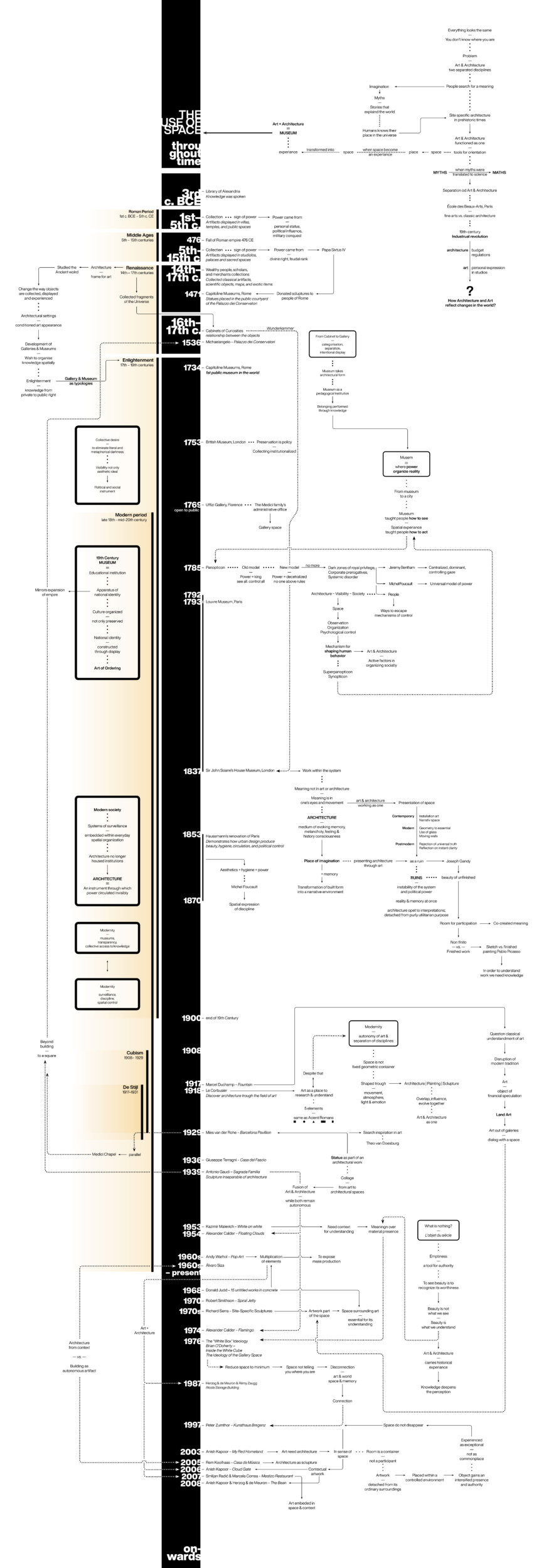
The red thread of art and architecture
- Mentor
- Asst. Prof. Dr. Miloš Kosec
- Študijski programi
- Enoviti magistrski študijski program druge stopnje Arhitektura (EMŠA)
- Študijsko leto
- 2025/26
It can be argued that by studying how art influenced architecture and architecture influenced art, we are simultaneously speaking about social development. Art and architecture function as tools of human orientation, of narrating time, the way humans think, and the level of technological development of the period in which they are created. The relationship between architecture and art is a dynamic system that, throughout different historical periods, reflects the values of a particular society while simultaneously transforming it. Architecture and art are formed within the systems in which they emerge, regardless of whether they support or criticize their ideology.
The central idea of the thesis is that art and architecture are not separate disciplines, but interconnected systems through which humanity constructs meaning, perception, and spatial experience. The relationship between art and architecture continuously develops together with broader cultural, political, and technological transformations, yet art and architecture remain fundamentally intertwined because both shape the way people orient themselves in the world. The thesis argues that architecture is never merely functional, just as art is never merely visual representation. Both disciplines function simultaneously as physical, emotional, symbolic, political, and experiential practices. Architecture frames perception and materializes ideology, while art challenges, broadens perspectives, destabilizes, and reinterprets spatial experience.
Throughout history—from sacred spaces and mythological beliefs to museums, modernism, conceptual art, installation art, and contemporary spatial practice—the boundary between art and architecture continuously changes and reforms itself. The thesis also suggests that modern attempts to separate art from architecture through institutionalization, functionalism, and commodification were never completely successful. Even in moments of apparent autonomy, the two reconnect after a certain time with context, narrative, and ideology. Contemporary spatial practice increasingly reveals that meaning does not arise solely from isolated objects, but through relationships with environment, movement, memory, atmosphere, and interpretation.